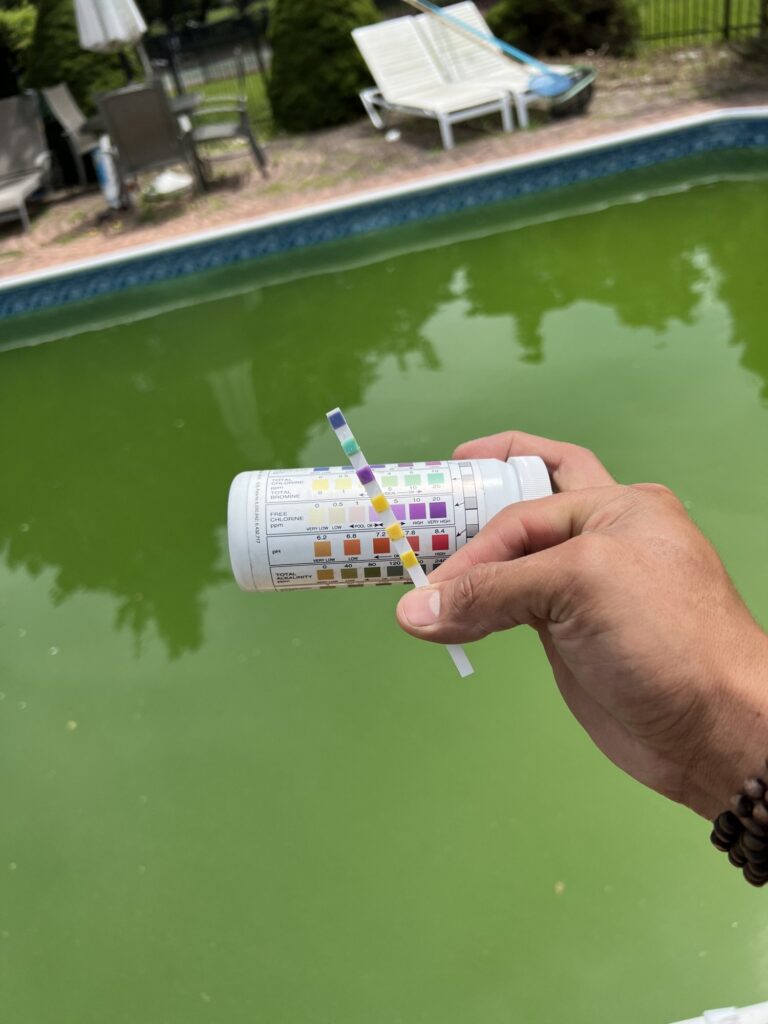
Yes, your pool needs chemicals for the winter, and the most important job is balance, not chlorine. A closed pool sits still in cold water for months. Cold water needs more calcium to stay balanced, and if it doesn’t get it, it takes calcium from your plaster, your liner and your equipment.
Here is why winter water turns corrosive, how to figure out what to add, how to add it safely and how to store your chemicals until spring.
Why does a closed pool need chemicals?
In the summer, the goal is safe, clear water, so chlorine comes first. In the winter, the goal changes. The pump is off, the water isn’t moving, and unbalanced water just sits against your pool for months.
Cold water makes it worse. Cold water needs more calcium than warm water to stay balanced. Water is always looking for balance, so if the calcium is low, it pulls calcium from wherever it can find it. That leads to:
- Liners that fade faster than they should
- Liners that get weak and brittle
- Plaster walls that get damaged for good
- Equipment that wears out sooner
Once the water is balanced, then you think about chlorine and clarity.
How do you know what chemicals a pool needs for winter?
Pool pros use the Langelier Saturation Index (LSI). It is one number that tells you whether water is balanced, corrosive or likely to scale. It is based on:
- Water temperature
- pH
- Total alkalinity (TA)
- Calcium hardness (CH)
- Stabilizer (CYA)
- Total dissolved solids (TDS)
Most of those come from a normal water test. The one people skip is temperature. For winter, plan for the cold temperature the water will drop to, not today’s reading. Water that looks balanced at closing can turn corrosive as it gets colder.
Aim for an LSI a little above 0, around 0.15. Zero is balanced, but rain, leaves and pine needles make the water more acidic over the winter, so a small cushion helps.
A calcium hardness above 500 is a good place to start. From there, raise the calcium or the total alkalinity until the LSI reaches about 0.15. Raising total alkalinity also raises pH, and both raise the LSI.
You need three things: your test results, the winter water temperature and your pool’s volume.
To estimate your pool’s volume in gallons: length x width x average depth x 7.5. Use an average depth of 6 feet for inground pools and 5 feet for above ground pools.
Example: a 16 x 32 foot inground pool is 32 x 16 x 6 x 7.5 = 23,040 gallons.
Then use a free LSI calculator, like Orenda’s pool dosing calculator at orendatech.com/pool-dosing-calculator:
- Set the pool type to residential.
- Enter your pool volume in gallons.
- Enter your test results as the current levels.
- Enter your winter targets as the desired levels, with the water temperature set to about 35 degrees.
- Raise calcium hardness, and alkalinity if needed, until the LSI reads about 0.15.
- Pick the chlorine type you’ll use (we usually add liquid chlorine) and click calculate.
The calculator tells you how much calcium chloride, sodium bicarbonate (baking soda) and chlorine to add for your pool.
How do you add winter chemicals safely?
Follow the Safety Data Sheet for each chemical. You’ll need:
- Safety gloves
- Safety glasses
- A 5-gallon bucket
- A paint stirring stick
Then:
- Fill the bucket about two-thirds of the way with water.
- Add the chemical to the water. Never add water to the chemical.
- Add no more than 10 pounds of a chemical at a time.
- Never mix two different chemicals in the bucket.
- Stir until it is fully dissolved.
- Pour it around the edge of the pool.
- Repeat until you’ve added the full amount.
Where should I store pool chemicals over the winter?
- Keep them in their original containers or bags. Moving them into other bins is how chemicals get mixed up or mislabeled.
- Keep them in a cool, dry, well-ventilated spot, and up off the ground so moisture can’t get in.
- Never store chlorine and acid together. That can be dangerous.
- Keep chlorine away from metal, since it corrodes it over time.
- Close every lid and bag tight. Open containers lose strength and can give off harmful fumes. We often find open bags when we open pools in the spring.
- Read the label on each chemical for its storage rules.
Want us to balance your water at closing?
Every Romanelli Pools closing on Long Island includes balancing the water, plus a free bottle or two of winter water clarifier. Closings are $299 for above ground pools, $369 for inground pools and $569 for inground pools with a spa. If you need help with your water between visits, a chemical service call is $150.
Call or text us at (631) 472-6275.