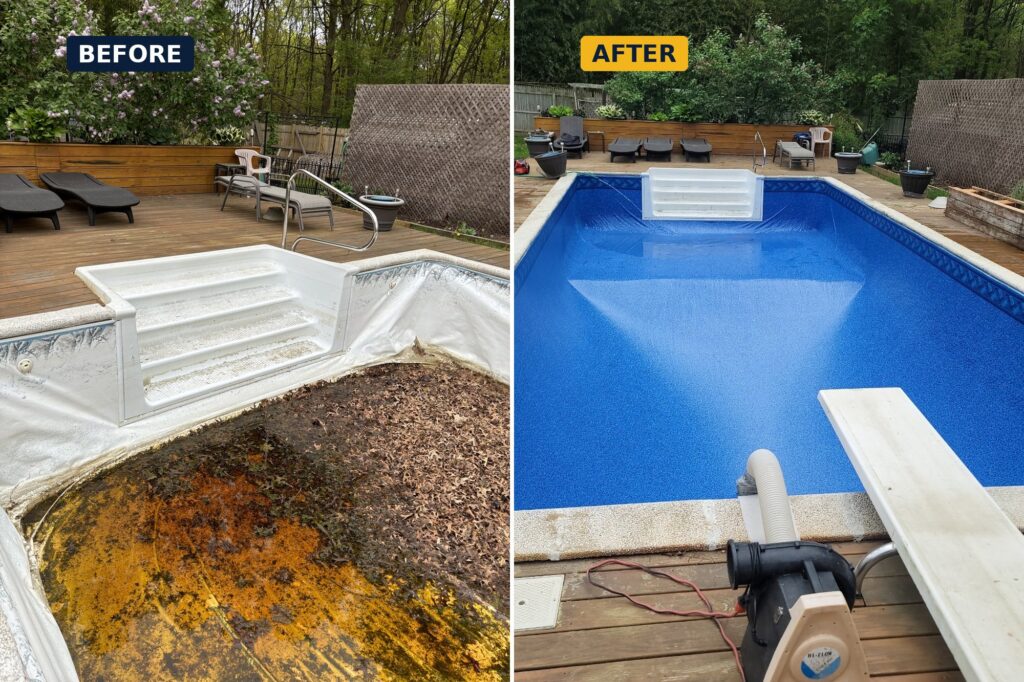
A vinyl liner does not last forever. Most last 10 to 15 years. The hard part is knowing when a patch will do and when it is time for a new one. Here is how we decide, what it costs on Long Island, and how the job works.
The short answer
Replace your liner when the tear is in a spot that keeps pulling, when the vinyl is brittle or bleached, when it is pulling out of the track, or when it has more than one leak. A small hole in a flat spot on a liner that still has stretch can be patched. Most Long Island inground liner replacements run about $6,000 to $9,000 installed. A standard 16 x 32 starts around $6,200.
Patch or replace?
A patch works on a small hole in a flat spot, on a liner that still has some stretch to it.
Replace the liner when:
- The tear is where the liner keeps pulling. That means corners, step edges, along the track, or low on the deep end wall.
- The liner is brittle or bleached. Chlorine tabs in the skimmer bleach and wrinkle the vinyl. That cannot be patched.
- It is pulling out of the track, sagging, or bubbling.
- There is more than one leak, or a patch already failed.
- It is 10 to 15 years old and faded.
If the tear is in a stress spot, you will likely pay for a patch and then a liner anyway. Not sure you have a leak at all? Read how to know for sure if your pool has a leak.
We see the same three causes again and again:
- Corners pulling out of the track.
- Chlorine tabs bleaching the vinyl under the skimmer.
- Tree roots pushing up from below.
What a new liner costs on Long Island
Most Long Island inground liner replacements run about $6,000 to $9,000 installed. A standard 16 x 32 starts around $6,200.
Steps, odd shapes, thicker vinyl and textured patterns push the price up.
One price covers it all: labor, new foam behind the walls, faceplates, bead lock, draining, startup chemicals and the visits. You refill the pool with your own hose.
There is no sales tax. A liner replacement is a capital improvement.
Want an exact number? Use our liner price calculator.
Which liner thickness should you pick?
Loop-Loc makes three choices:
- 20 mil. The standard liner.
- 20/28 combo. The walls are 28 mil and the floor is 20 mil. The walls get the sun, so thicker vinyl there holds up better to UV damage.
- 28 mil. The thickest.
Is thicker worth it? Both last 10 to 15 years. Your water chemistry matters more than the thickness. Loop-Loc liners carry a 20-year pro-rated warranty when a pool pro installs them.
Picking a color or pattern
Dark liners show every dent in old, packed sand on the pool floor. Keep that in mind if your floor has some wear.
Always pick a backup pattern too. If your first choice is out of stock, the job does not stall.
How we measure
Every liner is custom made for your pool. We size it for your quote. Then Loop-Loc measures on site before anything is cut. On tricky shapes, the installer watches the corners and uses liner stoppers.
The cover has to be off to measure. That can happen in winter if your pool is uncovered, but most measuring happens in spring.
Vinyl-covered steps need a clear view to measure right. If the water is cloudy, or the steps have concrete under the vinyl, we pump the pool down below the steps first. Sometimes we cut the old liner to measure the steps exactly. It is coming out anyway. Our crew brings a pump to the cover removal, so this all happens the same day.
Fiberglass steps do not need any of this.
We replace the parts behind the liner
We do not reuse old parts. Every job gets new wall foam, new faceplates and new bead lock.
How long does it take?
Plan on about 4 to 5 weeks from your deposit:
- About 1 week to measure and confirm.
- About 2 to 2.5 weeks to make the liner.
- 3 days to install.
The install goes like this. Day 1, we drain the pool, pull the old liner, set the new one and mark the fill line. You fill the pool with a hose. Day 2, we cut the faceplates. Day 3, we balance the water and start up the pool.
The installer needs sunny days around 60 to 65 degrees. That makes spring and early fall the best times.
A real story: a leaking liner in the fall
One of our customers had a 4-year-old liner. A storm left a 2 to 3 inch gash low in the deep end. The patch failed. The pool lost 3 to 4 inches overnight. Then a second pinhole showed up by the steps.
The fall timing made it worse. A pool that drains over winter under a safety cover has no water holding the cover up. Snow then loads the straps and springs. You can end up buying a new cover on top of a new liner.
The choices were to replace it now, put a deposit down now to lock the price for spring, or wait and risk the cover.
The lesson: if your liner is losing water in the fall, do not just close it and hope.
How to compare liner quotes
Ask each company the same questions:
- Is everything in the price? Foam, faceplates, bead lock, draining, chemicals and visits?
- Is the thickness the same on both quotes?
- Who measures, and how many times?
- What brand is the liner?
- How do they handle steps, roots, a bad track or a high water table?
A patch quote is not a liner quote. Make sure you are comparing the same job.
How paying works
A 50% deposit places your order. The balance can be split into interest-free monthly payments.
Your next step
Get your instant price on our liner price calculator. Then book a free measurement and put your 50% deposit down.
Pool equipment prices go up every year. The sooner your deposit is in, the less risk of a price increase hitting your job. A deposit also gets you on the early spring install list. That list fills fast, because liners go in before openings.
Prefer to talk? Call or text (631) 472-6275.